
Category: Uncategorized

  • A Question of Political Taxonomics

    A Question of Political Taxonomics

    The EU’s Regulatory Framework on Sustainability in Financial Investments: From Disclosure to Taxonomy

    The EU’s regulatory requirements for sustainability in financial investments have now been completed with the Taxonomy Regulation following the Disclosure Regulation. After more than 40,000 comments were received during the consultation phase, the most enlightening insights are found not so much in the legal text itself, but in the 60 recitals that precede the Regulation and explain its rationale.

    With rare candor, one can read in Recitals 9–11 that the European Parliament and the Council, through Regulations (EU) 2019/2088 and (EU) 2020/852, are not aiming solely at sustainability. They also intend, almost incidentally, to reshape the European financial system. The financial industry is being instrumentalized as a means to an end: to steer and control capital flows within the Union. For instance, it is stated that “the financial system should be gradually adapted […]” so that it “supports the economy in a way that allows it to function sustainably.” To achieve this, a new form of finance must become “the standard.”

    Naturally, the financial industry lends itself quite well to being exploited for political purposes. Since Member States have delegated conceptual regulatory tasks to the EU, the Union can now use regulations like those mentioned above to define the room for maneuver for financial market participants in such a way that they are almost compelled to act in the centralized interest of EU institutions—thereby undermining the subsidiarity principle and the economic policy competencies of individual Member States.

    The European treaties, like the EU Constitution itself, were written in the spirit of a principal-agent relationship between the governments of the Member States and the EU institutions. That’s why (also in economic policy) the ultimate directive authority has always remained with the sovereign states.

    This limitation of power is a thorn in the side of many EU bureaucrats. It’s therefore not surprising that in recent years there have been increasing Machiavellian efforts to shift directive authority and decision-making power from the Member States to the European institutions.

    When delegated supervisory powers are misused to exert influence on Member States’ economic policy—under the guise of ecological sustainability—this constitutes nothing less than a breach of the EU constitution.

    Once one works through the Taxonomy Regulation to the actual legal text, it becomes apparent that the EU has largely abandoned the ESG triad of Environmental, Social, and Governance objectives. The Regulation focuses almost exclusively on environmental sustainability goals. Yet even here, no guidance is provided on how sustainability should be measured or evaluated. Instead, the Regulation contains numerous diplomatic compromises. For example, Article 19(2) allows the inclusion of nuclear energy’s carbon-free status, or—somewhat humorously—declares that “[…] a significant increase in the generation, incineration or disposal of waste constitutes environmental harm – with the exception of incinerating non-recyclable hazardous waste.”

    However, the urgently needed standardization of ESG evaluation criteria remains elusive. Article 19 of the Taxonomy could even be interpreted to mean that at least quantitative assessments of sustainability impact must rely solely on indicators, methods, models, or certifications recognized by the European Union.

    The obligations for financial market participants and advisors are primarily qualitative in nature and mostly aimed at consumer protection. A central requirement is disclosure and justification—why a product is classified as sustainable, what objectives it pursues, and how these are to be achieved. To meet these regulatory requirements, the financial industry will likely have to rely even more heavily on purchased data and ESG ratings in the future.

    Yet it is well known that ESG ratings from different providers vary significantly. Various studies on this topic have reached very similar conclusions. As representative evidence, the bottom left image shows a scatter plot from Fiduciary Advisors comparing ESG ratings from MSCI and Sustainalytics for S&P 500 companies. The coefficient of determination is just 0.29—visibly low—yet consistent with findings from other analyses.

    Evidently, the sustainability assessment of an individual company depends heavily on which data is used. In light of the regulatory requirement to demonstrate overall sustainability impacts for financial products—by comparing them to a sustainable benchmark index and a broader market index—it is even more problematic that such rating discrepancies persist across entire portfolios.

    In our own analysis (top right of the image), we evaluated ESG risk for indices in the MSCI Europe family using data from both providers. The correlation was virtually non-existent. When broken down by sector (not shown here), a growing ESG focus by MSCI even led to lower ESG risk scores in one-third of industries—when assessed with Sustainalytics data.

    In other words, even when regulatory requirements are implemented consistently by all parties, the same product can be evaluated and advised on in entirely different ways by different financial actors. The regulations’ intended goals—investor education and product transparency—are thus rendered meaningless.

    The Taxonomy answers only some of the questions raised by the preceding Disclosure Regulation. It allows broad room for interpretation and thus introduces legal uncertainty. It also risks confusing potential clients more than it helps them. For disclosure of ecological assessment criteria to be genuinely valuable to investors—and to enable sufficient comparability of financial products’ sustainability impacts—a standardized evaluation process is essential. A first step in the right direction could be mandatory ESG audits of companies. The resulting standardization of a binding set of data would likely lead to greater convergence in the ratings provided by agencies.

    Until then, developing one’s own evaluation method might be worth considering. We have had positive experiences with a methodology that relies exclusively on publicly available data sources and yields surprisingly strong results, particularly in the often-neglected “S” and “G” categories. Details of this method are beyond the scope of this brief. But if you’re interested, feel free to reach out to us.

    Let’s end with some good news: For financial firms feeling squeezed by the triple burden of COVID, regulation, and climate change, the Taxonomy offers a way out—complete with a pre-formulated disclaimer. Just copy and paste it onto your website if needed:

    “The investments underlying this financial product do not take into account the EU criteria for environmentally sustainable economic activities.”


  • The Road to Serfdom – Climate Change and the Open Society

    The Road to Serfdom – Climate Change and the Open Society

    At the latest since the hastily enforcement of the Offenlegungsverordnung (EU Regulation), the topic of sustainable investment has become part of asset manager’s everyday life. No lecture, no webinar or newsletter, not even the FAZ can avoid highlighting at least one ESG aspect every day. Today, investors have a wide range of products for sustainable capital investment at their disposal. In these, the topic of climate protection, or the reduction of CO2 emissions, not only overshadows other sustainability criteria in the “S” (Social) and “G” (Governance) areas, but also other “E” (Environmental) aspects.

    Fear of climate change and its potentially drastic consequences has now reached all sections of the population and increased the social pressure on everyone to take responsibility and help protect the climate.

    The Intergovernmental Panel on Climate Change (IPCC), founded by the UN, plays a crucial but dazzling role in this development. The IPCC consolidates scientific work on man-made climate change and thus sets the agenda for world climate summits. The selection of scientific contributions follows political interests, so that one cannot speak of neutral reports. For example, it came to light that some of the scientific work was commissioned or financially supported by the IPCC itself, or that the results were predetermined. Research results that are not in line with the political interests of the IPCC are ignored, the work is often discredited and the authors are sometimes even defamed. In this way, the theory that humans are the sole cause of climate change is dogmatized.

    In fact, although a correlation between the CO2 concentration in the atmosphere and the temperature measurements of the last 100 years or so can be identified, a causal, physical relationship between CO2 emissions, the greenhouse effect and global warming has neither been explained nor proven scientifically to date.

    The basic assumption that human CO2 emissions are the only cause of climate change is therefore built on sandy ground. In addition, the CO2 emissions of humans of about 40 billion tons p.a. are offset by natural CO2 emissions of the earth of between 700-800 billion tons annually. This means that the CO2 emitted by nature not only exceeds the current total amount of CO2 emitted by humans by a factor of almost twenty, but also that the annual fluctuation of natural emissions alone is greater.

    The Earth has mechanisms for counteracting natural fluctuations in order to stabilize them. In particular, the oceans absorb or release CO2 depending on temperature, so that a balance is created between the CO2 bound in the ocean and that in the atmosphere. The intensity of cloud formation by means of the water vapor contained in the atmosphere is also temperature-dependent and has a stabilizing effect.

    The idea that in a few centuries we humans could overturn something that has survived 550 million years in the youngest earth age Phanerozoic alone seems like the modern version of the geocentric view of the world.

    Thus, it is more likely to be political goals that make the Intergovernmental Panel on Climate Change adhere to the theory of man-made climate change. These, in turn, become clearer when looking into the future of the year 2030: According to the Paris Climate Agreement, all companies worldwide will then have to present corresponding emission certificates for their CO2 emissions. Countries will issue certificates to domestic companies for the amount of CO2 emissions that will then still be permitted. Since it is foreseeable that it will not be possible to achieve the necessary emission reductions by 2030, companies will in future be able to acquire additional emission certificates via a global trading platform. The operator of this platform is the Intergovernmental Panel on Climate Change or the UN. The commissions alone for the certificates traded on the platform are estimated to be around USD 250 billion.

    But if we think it through to the end, it’s about more than just money.

    Pricing CO2 emissions on the basis of (inter)governmental targets, quotas and regulations will enable governments to control and steer economic activities. The path thus mapped out towards central planning runs counter to all the basic principles of a free society. It subtly but massively attacks the open society as such.

    But back to capital investment: it is especially the institutional investors who have the financial means and the human resources to develop their own sustainable capital investment strategy outside of today’s ecologically dominated standard. In this way, they not only reduce economic misallocations of capital, but also prevent concentration risk in their own portfolio caused by an overweighting of climate protection. It is therefore to be hoped that institutional investors will become aware of their great – also social – responsibility.

  • What the Discussion about Inflation Reveals

    What the Discussion about Inflation Reveals

    The ongoing coronavirus pandemic presents us all with unprecedented social and economic challenges. Between lockdown, incidence statistics, a European vaccine disaster, the surge in the stock market and simultaneous decline in the bond market, the specter of inflation has now also taken hold. The topic is being controversially discussed in the current economic situation. No wonder, as there are few historical experiences to fall back on for this economic (crisis) scenario. In a normal growth phase, inflation can arise from a faster increase in wages compared to the increase in production. The central banks then try to limit inflation with restrictive monetary policy and prevent an upward wage-price spiral. So far, the theory. However, the pandemic has set central axioms of the causal relationships aside. The crisis is particularly characterized by the fact that a part of production was paralyzed almost overnight in a fundamentally healthy economy and the demand for many goods suddenly declined. Due to the external shock, lower demand met with a smaller supply, which had the advantage that prices remained largely stable despite the completely different economic performance. In fact, after the outbreak of the pandemic, the rate of inflation remained relatively low, even deflationary, for a long time. The output gap, which emerged overnight, is unparalleled in history. After more than a year and a half of crisis, the extent of the supply gap between production potential and actual production remains uncertain. How quickly and whether unused production capacities can be ramped up in a recovering economy can only be guessed at. Inflation forecasts are also made more difficult by the fact that the economic shock affects the world economy simultaneously. However, the recovery shows large regional differences due to divergent pandemic management.

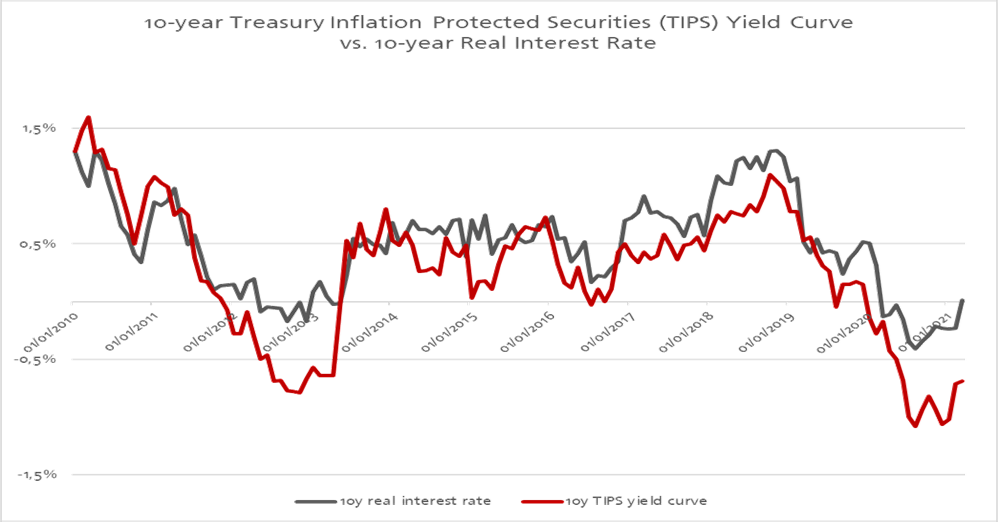
    The US indicator TIPS (10-year Treasury Inflation Protected Securities, see red line in graph) reveals that the markets are actually expecting rising inflation. The expansion of the spread between the American 10-year TIPS and the 10-year bond yields clearly shows the increasing willingness of market participants to pay a higher premium for inflation protection. This development began immediately after the outbreak of the pandemic and remains at a very high level today. It is a proven fact that high and rapidly rising inflation expectations lead to a real increase in inflation in the following years. They act like self-fulfilling prophecies, especially if the central banks do not react early with restrictive monetary policy to rising expectations. However, the currency guardians are faced with the dilemma of having to balance the trade-off between stimulating the economy and keeping inflation under control. This is especially challenging given the uncertainties about the magnitude and duration of the pandemic and its economic effects. In view of the above, it is likely that the central banks will remain accommodative for a longer period of time and that the general environment for investments will continue to be marked by low interest rates, a high degree of volatility, and increased uncertainty.

    In summary, the discussion about inflation reveals the challenges and uncertainties that the world economy currently faces. It is important to be prepared for a wide range of scenarios and to take a long-term perspective in investment decisions.

  • The Naked Truth

    The Naked Truth

    The events that have recently taken place in the stock market have been referred to using various metaphors such as David vs. Goliath, Empire vs. Death Star, or Robin Hood vs. King John. These refer to private investors who, via the Reddit community “WallStreetBets”, organized themselves to purchase shares, especially of GameStop (GME), causing a short squeeze of the invested short sellers. Several well-known hedge funds suffered losses ranging from 10-30% and had to turn to support from the industry and lobbying with brokers to prevent larger damages.

    It is now evident that the mobilization of investors was by no means accidental. A handful of experienced and familiar protagonists with the rules of Wall Street carefully selected the companies involved, knowing the engagement of the respective hedge funds, and brought not only insider knowledge to the community but also concrete recommendations around the trading of the proposed positions.

    Short-term speculative goals were likely not a central factor driving the actions of most investors. Instead, the community was driven by the prospect of giving the Wall Street establishment a collective slap on the wrist. As for the initiators, their motives may lie somewhere between personal grudges and political ideology. Therefore, it does not surprise us that the demonstration of power with 6 million mobilized private investors disregarded the unwritten law of Wall Street, not to attack any competitors, despite clearly good industry knowledge.

    Did the initiators only aim to bring some hedge funds to the brink of insolvency? According to the latest entries in the Reddit community, this goal was not achieved.

    Looking at the Short Interest/Float Ratio, we believe we can see a larger scenario. At the end of December 2020, this stood at 260%, before giving way during January, but still stood at 140% on January 28th, 2021. The normalization only began when private investors were cut off from trading by their brokers on Friday, January 29th, 2021. As a result, the Short Interest/Float Ratio fell to 113% on the same day and is now around 40%.

    The short interest/float ratio shows the number of shorted shares compared to the total number of shares in the free float. Generally, a ratio of 35-40% or higher is considered extremely high and potentially dangerous for the company. In exceptional cases, this ratio can be over 100%. This happens, for example, when a market participant buys shares borrowed from a short seller, and the broker of that market participant then loans the purchased share to another short seller. This can explain short interest/float ratios of 113% or 140%, but not one of 260% as was the case with GameStop at the end of 2020. With a free float of about 50 million for GME, 130 million shares were shorted in January. At this magnitude, it is almost impossible not to suspect that a significant part of the short sales are counterfeiting or illegal naked shorts.

    The idea of naked shorts is simple: the short seller sells shares that he could not (or did not want to) borrow. This creates counterfeit shares, i.e. shares that previously did not exist in the market. From a criminal law perspective, this corresponds to the offense of bringing counterfeit money into circulation.

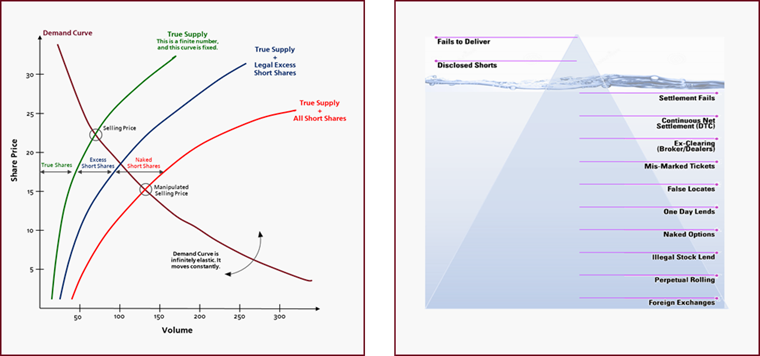
    Although naked shorts on Wall Street and in Europe are strictly regulated by the SEC and ESMA, it is an open secret that the practice continues to be widespread. The supervision mainly focuses on the Fail-to-Deliver indicator reported by the exchanges, which shows the number of shares for which a trade has taken place but the stock package could not be settled afterwards. This is a characteristic sign of counterfeiting. For example, the Nasdaq reports 100 million shares daily as Fail-to-Deliver. This is only the tip of the iceberg: there are various ways and strategies for short sellers, brokers, and the central clearing house to create the conditions for naked shorts and delay the need to report Fail-to-Deliver events (see illustration to the right).

    Counterfeit shares always increase the number of tradable securities in the market. The advantages for the short seller are obvious. The massively increased supply of counterfeit shares manipulates the market price during the sales transaction and also leads to a sustained dilution of the company’s value (see the figure above left). The risk of exposure of illegal activities is low for those involved due to the technical and systemic possibilities for obscuring such transactions.

    The problem for the entire system arises when a high proportion of naked shorts occurs and short sellers are forced to cover their positions. The leverage effect then works in the opposite direction and turns against those with naked shorts. As a result of the inevitable escalating fail-to-deliver events, not only the extent of illegal practices is revealed, but also which players are involved.

    Did the initiators of the mobilization of the private investor community possibly aim to enforce this transparency? If systematic illegal transactions by an interwoven network are confirmed, the consequences could trigger seismic waves through the international financial system.

    This would also explain the panicked reaction of the establishment to recent events. Several large hedge funds rushed to provide liquidity to the distressed company in an unusual way. The forced trading halt of the affected securities for private investors by brokers, allowed short sellers to cover their positions at the last moment due to the 40% drop in demand caused by the abrupt halt. If the action actually missed the true goals of the initiators and the swarm, new “attacks” are likely not to wait for long. In the end, a showdown in the spirit of David versus Goliath, Empire versus Death Star, or Robin Hood versus King John may take place. The losses on all sides will not be small, that much is already certain.